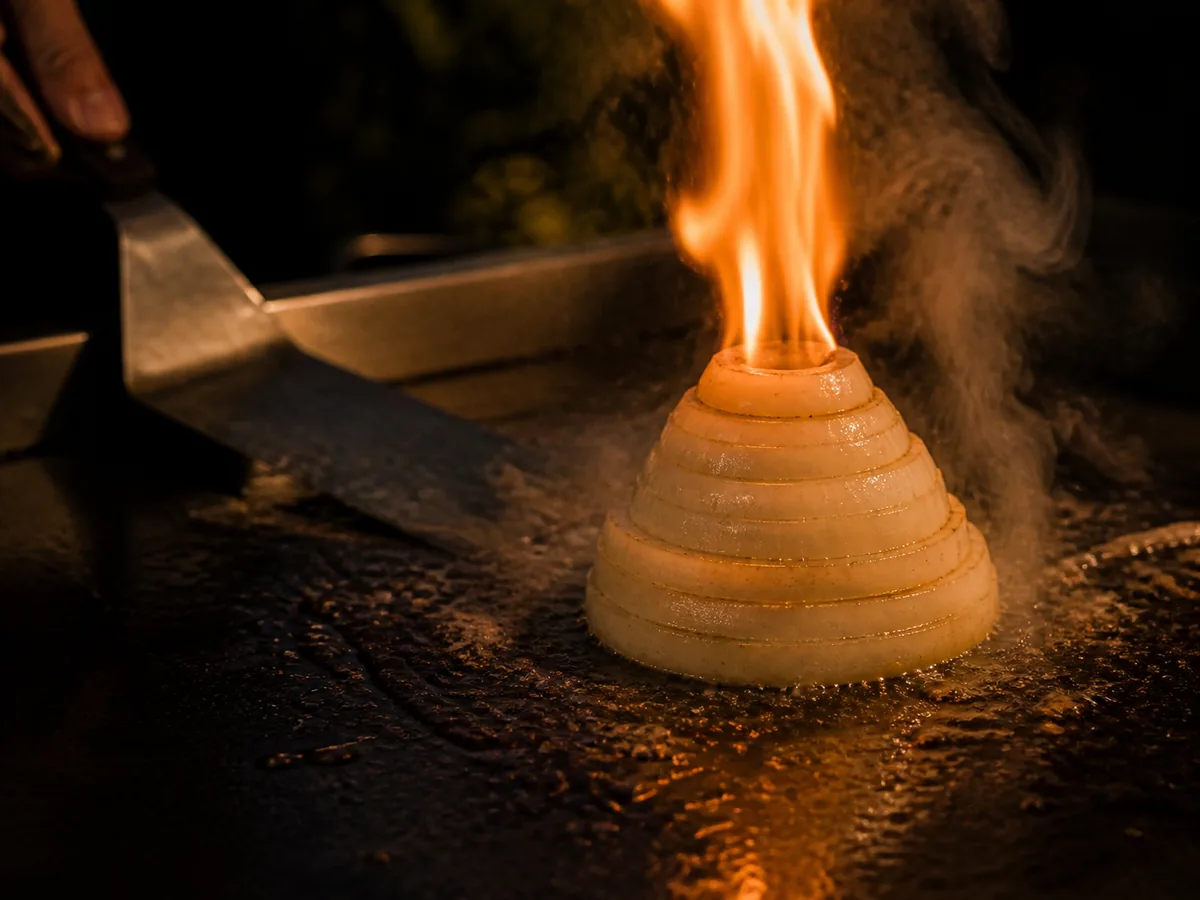
It is the single most photographed thing we do. Not the steak, not the lobster, not the twenty-minute knife work that actually takes years to learn — the onion. A stack of rings, a little oil, and a column of flame that goes up about four feet and comes down in three seconds.
Here is what is actually happening while everyone reaches for their phone.
It starts with the wrong onion
A sweet onion is the wrong choice, which surprises people. Sweet varieties carry more water and more sugar, so they slump when they heat and scorch before the stack is built. What you want is a firm yellow onion, large, with tight concentric rings that separate cleanly.
The chef cuts across the equator, never through the root. Cutting through the root gives you rings that are joined at one edge and they will not nest. Across the equator gives you perfect circles, each a little smaller than the last.
The stack
Four rings is the working number. Three looks mean, five gets unstable and tips at exactly the wrong moment. The rings go down largest first, and each one sits inside the last rather than on top of it, so the whole thing forms a shallow cone with a chimney down the middle.
- The base ring does the structural work and never moves once it is down.
- The middle two are the ones the chef adjusts — a quarter turn to line up the gaps.
- The top ring is small enough to hold the oil without it running straight through.
That chimney matters more than the stack. It is what turns a puddle of burning oil into a column. Without it you get a wide, low, orange flare that photographs badly and dies immediately.
The timing
The grill sits around 400 °F for most of the service. For the volcano the chef works a hotter patch, usually the back-right of the flat-top, where the burner runs closest to the surface.
Oil goes into the chimney, not over the stack. A splash over the top gives you a fireball and a smell of burnt onion for the rest of the night. Into the chimney, it pools at the base, heats fast, and the draw up through the rings does the rest.
Then the chef waits. This is the part nobody notices and the part that separates a good volcano from a great one — about four seconds of doing absolutely nothing while the oil comes up to temperature. Light it too early and it gutters. The gasp comes from the pause as much as the flame.
Why it still works
We have done this in something over four thousand backyards. It has never once failed to turn every head at the table, including the people who have seen it before, including the chefs' own families.
Our best guess is that it is the only part of dinner that is genuinely dangerous-looking and completely safe. Everyone knows nothing bad is going to happen. They flinch anyway.
Ask your chef to walk the kids through the stack before they light it. Most of them will, and it turns four seconds of spectacle into about ten minutes of the children being completely absorbed.